The UK map: where the firms actually are
The UK map plots 80 registered-office rows: 53 in London and 27 elsewhere. RAND Europe CIC appears for context but sits outside the 90-firm catalogue. Nine entities lack a separately filed address. Scope matters. The catalogue has 90 entries: 80 active filed entities, two dissolved firms retained for continuity and eight parent-filed or otherwise without standalone status in the export. The 80 plotted rows include separately registered brands at one address (three A&M LLPs, two Capital Economics companies and two ECA names), as well as the dissolved Vivid Economics and Indepen Consulting. They are not a count of distinct active firms. NEF Consulting and Skylark Consulting Group have Companies House-filed London offices but are not plotted. The other nine non-plotting entities remain in the dataset but never appear on this map.
London dominates, but does not monopolise, the map. Tight clusters fill the capital; a thinner scatter reaches Oxford, Cambridge, Edinburgh and several regional towns. London itself divides into four groups. Each postcode hints at a different clientele. In this trade, an address can reveal part of the business model.
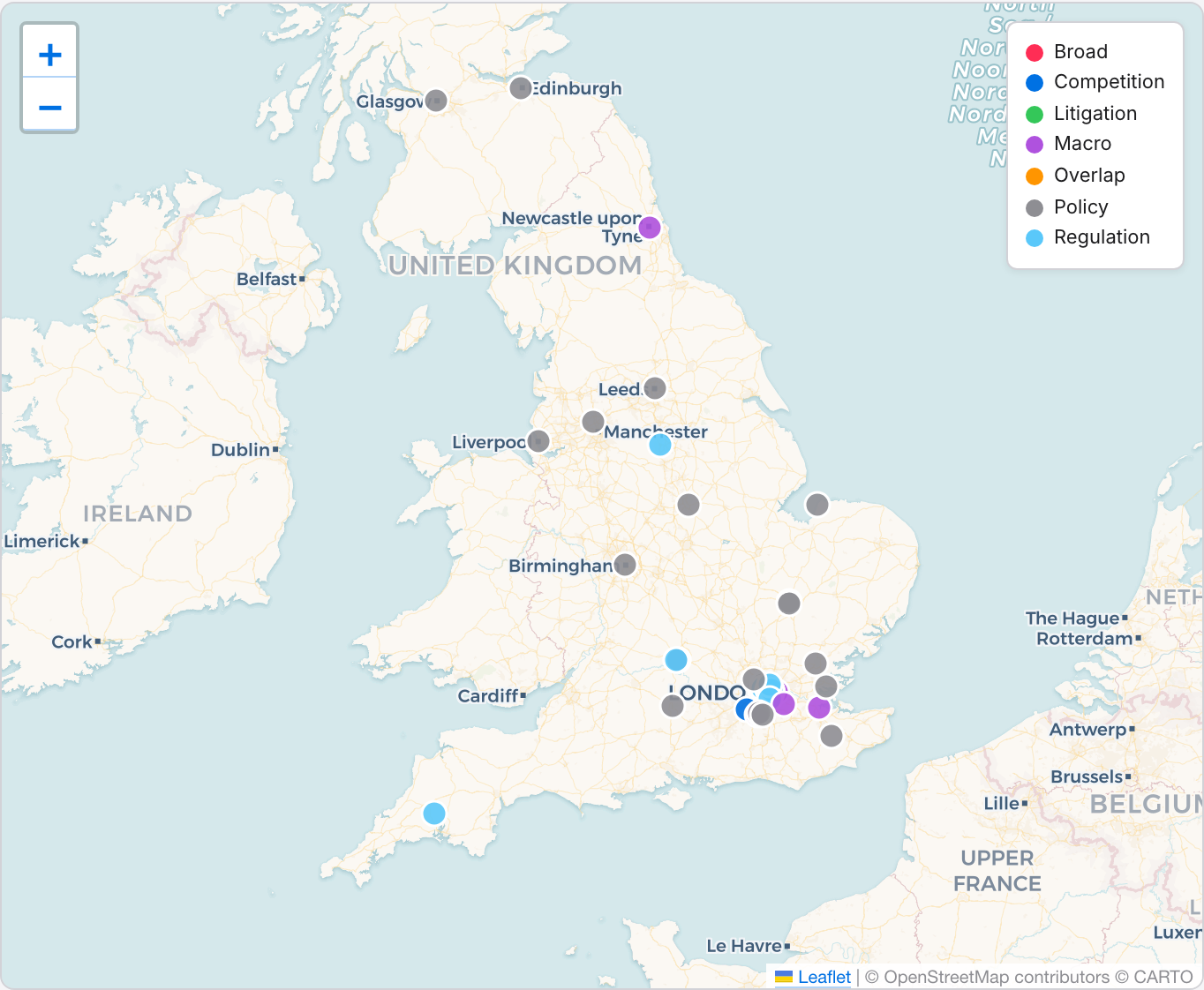
Cluster 1: the Square Mile (EC2, EC3, EC4). Litigation and disputes firms pack expert witnesses into a few blocks. FTI Consulting is on Aldersgate Street. A&M Europe, A&M Tax and A&M Disputes share 30 Old Bailey. Brattle Group occupies 100 Wood Street; CRA International, 8 Finsbury Circus; NERA, the St Botolph Building on Houndsditch; BRG UK, 8 Salisbury Square. Much of the cluster lies within a ten-minute walk and near the Royal Courts of Justice and Commercial Court. Expert witnesses have reason to stay close to the bench.
Cluster 2: the City fringe (EC2A, EC2M, EC2N). Competition and strategy boutiques sit just north. RBB Economics uses 199 Bishopsgate, on the EC2M edge of the Square Mile; Frontier Economics is at Worship Square on Clifton Street, EC2A, near Shoreditch. The postcodes differ from the disputes firms to the south, but remain a five-minute Tube ride from the Royal Courts of Justice. UCL, LSE and SOAS, useful reservoirs of academic talent, lie a little farther west. A competition economist can visit the CMA in the morning and brief a Linklaters partner on a merger that afternoon.
Cluster 3: Victoria and Westminster (SW1). Policy shops and political advisers sit near Whitehall and its departments. Baringa Partners occupies 62 Buckingham Gate, Capital Economics 100 Victoria Street and Independent Economics 15 Whitehall itself. Proximity to HM Treasury may matter commercially to public-affairs and regulation firms. That is an interpretation; the map proves location, not motive.
Cluster 4: the West End (W1). Macro research houses form the smallest group. Macro Advisory Partners is at 4 Albemarle Street. Mayfair also houses hedge funds and asset managers, putting the researchers near the subscribers who pay them.
Outside London are 27 firms. Four plotted rows cluster in Oxford. Oxera Consulting LLP is registered at Park Central on Park End Street, two minutes from the station. Oxford Economics Ltd sits on St Aldates. AFRY Management Consulting, a Swedish-owned energy-regulation practice, is a few doors away. SQW Ltd, an innovation-policy consultancy, works from the Oxford Centre for Innovation on Alfred Street. These four of the 27 non-London rows make Oxford the clearest cluster beyond the capital.
Cambridge has two: Cambridge Econometrics Ltd on Covent Garden, the Cambridge street rather than its London namesake, and RAND Europe CIC on Shaftesbury Road, outside the core catalogue. BiGGAR Economics Ltd is in Edinburgh; EKOS Consulting (UK) Ltd in Glasgow; Pantheon Macroeconomics Ltd in Newcastle; AMION Consulting Ltd in Liverpool; Warwick Economics & Development in Birmingham; and York Aviation LLP in Leeds. Residential and suburban addresses in Chelmsford, Benfleet, Rochester, Banstead, Stanmore, Hunstanton and Callington house the rest. For some one- and two-person boutiques, the registered office is the founder’s front room.
Now go global: which firms share a city with whom
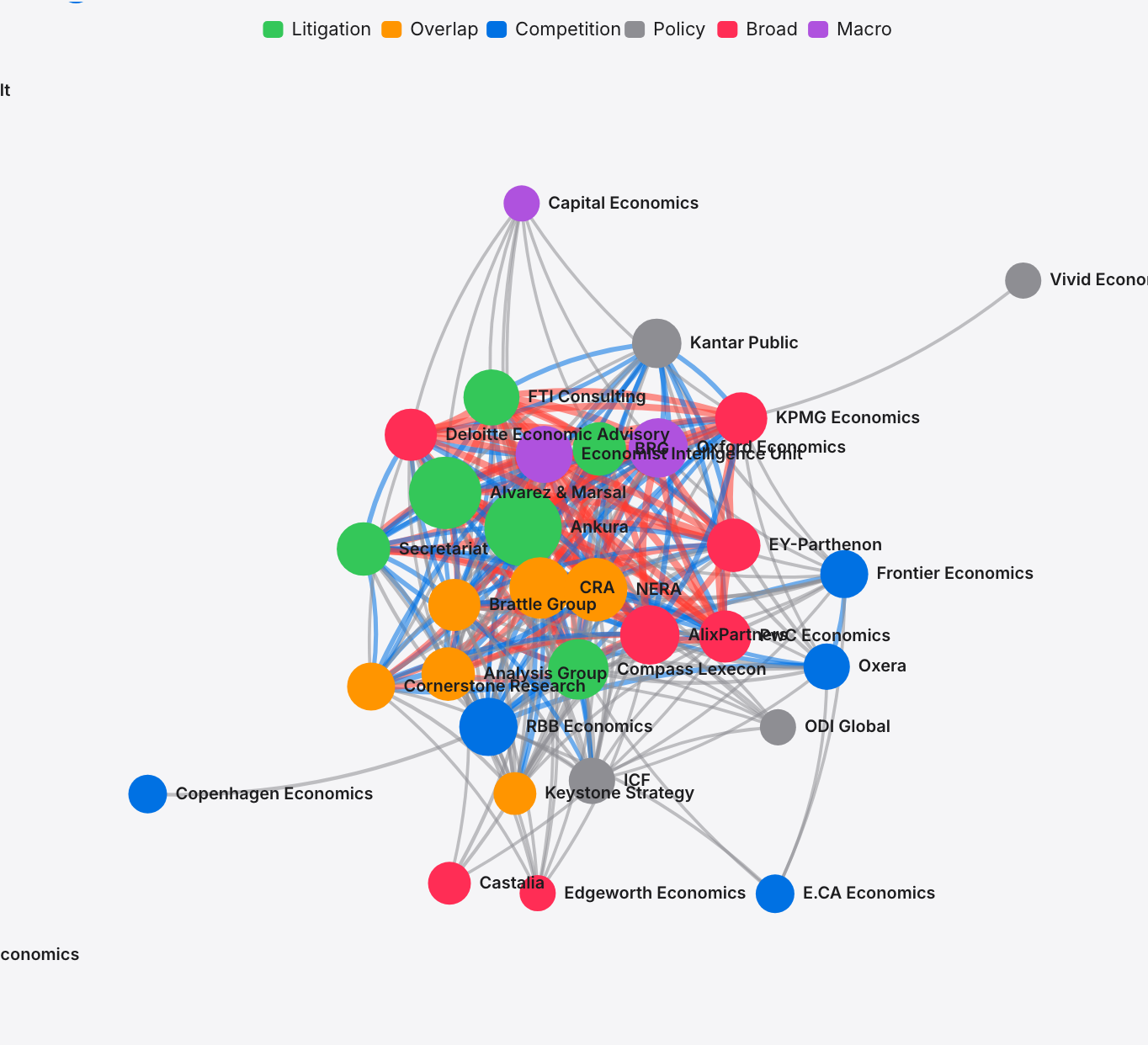
The force-directed graph covers 45 firms with tracked international footprints. Two firms share an edge when they operate in at least N of the same cities; the sidebar slider sets N.
The officer graph in NOTE H measured people flow: firms shared an edge when they had shared a director or LLP member. Compass Lexecon sat near its centre after two decades of documented staff moves. This graph changes the rule. A line now joins firms with offices in at least three of the same cities. It measures physical overlap, not shared people.
The hub moves to firms with broad footprints. Alvarez & Marsal, Ankura, Compass Lexecon, Oxford Economics and the Big 4 economics practices gather near the middle. DotEcon, Europe Economics, Credo, WIK-Consult, Bates White, Cebr and Fathom sit at the rim with one or two edges; some are isolated.
| Rank | Firm | Offices | Edges | Max overlap |
|---|
Where the global firms actually are
The same 45 firms from the network above, now pinned to a world map. Dot size = number of firms present in the city. Curves = HQ→office corridors, thicker when multiple firms share the same route.
The network shows structural overlap; the map shows where it occurs. Together they test a question left open by Part 7’s chord diagram: is the overlap global, or mostly London? Choose one category or firm and the dots move at once.
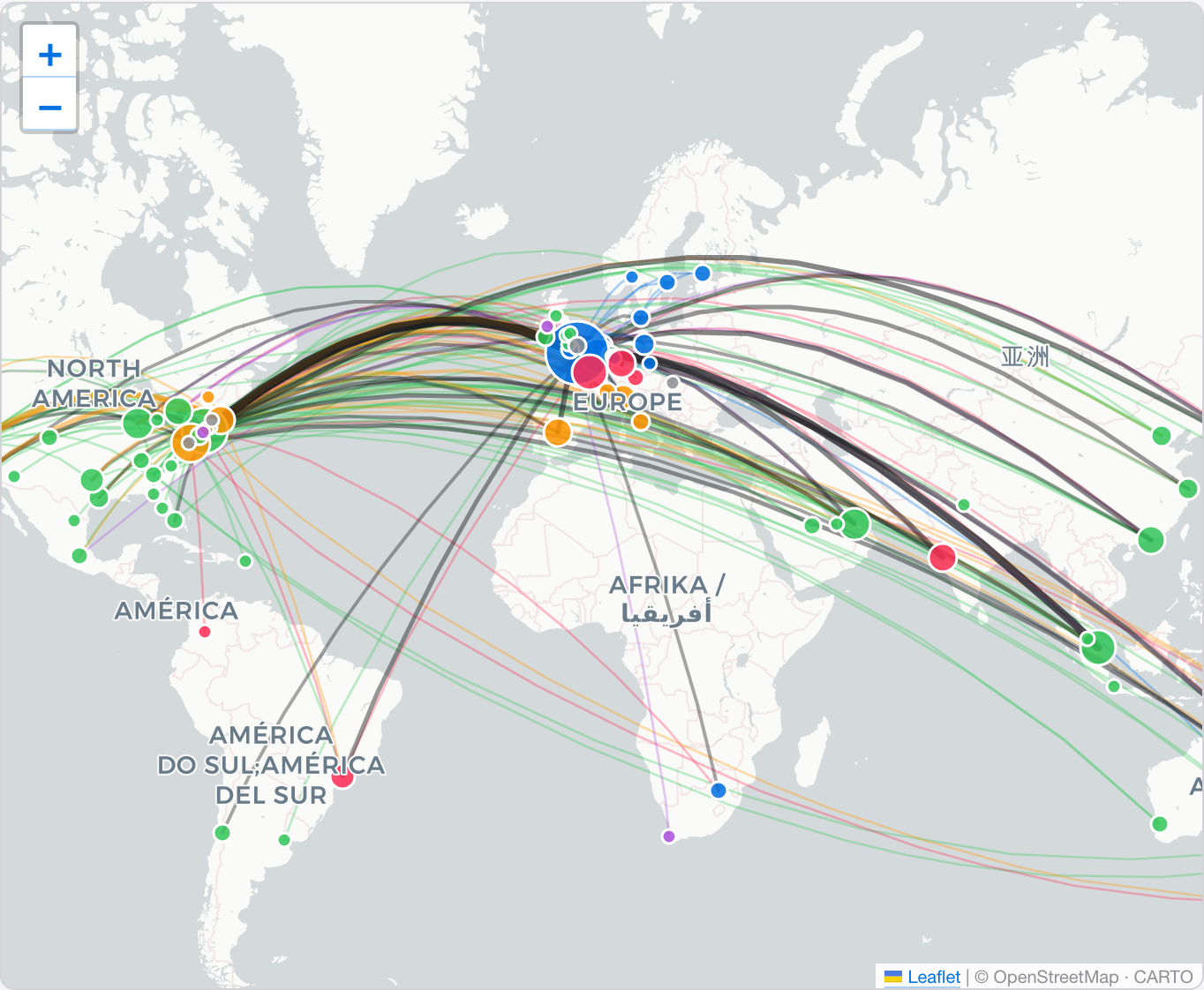
Dashed lines and hollow dots mark a wrinkle. The Economist Intelligence Unit has four branded offices: London, New York, Hong Kong and Dubai. It serves clients in a further 12 cities through the Economist Group network: Washington DC, Chicago, Los Angeles, Brussels, Frankfurt, Geneva, Paris, Johannesburg, Singapore, Tokyo, Shanghai and Mumbai. The graph counts all 16 as presence because EIU presents that footprint to clients. The map distinguishes EIU offices from access through the parent network.