The Profit Machine: 2020-2025, and the Next 25 Years
Part 5 of 7: 18 partners on one floor of 199 Bishopsgate produced the highest profit per partner visible among the detailed UK consulting-LLP accounts in this project. Elsewhere, McKinsey acquired Vivid Economics and Planetrics; Jacobs took full ownership of PA Consulting at an implied £3.05 billion valuation; and Econic launched with Goldman Sachs Alternatives funding. The filings underpin the scenarios that follow.
The £5.77 million line item
RBB Economics LLP lodged its FY25 accounts at Companies House on 23 January 2026. Note 8 records one member’s profit entitlement at £5,771,775. The accounts also show revenue of £108.4 million, operating profit of £61.0 million, 18 members and average profit per member of £3.34 million.
The filing does not identify the member. It discloses the entitlement, not its recipient. This article therefore treats the sum as an accounting line, not a named-pay claim.
No higher highest-paid-member line appears among the pure-play UK economics boutiques in this project’s Companies House sample. Magic Circle law firms, global accountants and large strategy houses sit outside the comparison; their statutory accounts rarely permit a clean member-level comparison. A&M Europe LLP does report a larger cash figure. But it is a 73-member, Europe-wide partnership with €301 million of revenue. RBB’s number belongs to a much smaller competition-economics LLP.
Part 5 follows the accounts from FY2021 to FY2025. Revenue rose from £60.7 million to £108.4 million. Members fell from 20 to 18. Profit per member climbed from £2.02 million to £3.34 million. The result came 23 years after the 2002 NERA walkout described in Part 2. The firm built by Ridyard, Bishop and Baker now posts the highest profit per partner in this project’s detailed-account LLP sample.
The RBB-Baringa comparison uses the FY2021-FY2025 account rows. The final section turns that evidence into scenarios.
Section 1: Two firms, two arithmetics
Put RBB beside Baringa over FY2021-FY2025. Both grew quickly; their member counts moved in opposite directions. RBB went from 20 to 18, whereas Baringa went from 98 to 178. That divergence determines how growth reaches each partner.
RBB Economics LLP, FY2021-FY2025
| Year | Revenue | Op Profit | Margin | Members | £/member |
|---|---|---|---|---|---|
| FY2021 | £60.7m | £40.8m | 67.2% | 20 | £2.02m |
| FY2022 | £62.9m | £39.6m | 62.9% | 19 | £2.06m |
| FY2023 | £75.0m | £46.2m | 61.7% | 19 | £2.40m |
| FY2024 | £82.0m | £44.0m | 53.7% | 18 | £2.41m |
| FY2025 | £108.4m | £61.0m | 56.3% | 18 | £3.34m |
Start with members. RBB entered FY2021 with 20 partners and now has 18. Revenue rose by 79 per cent over the same period. That is the machine’s basic arithmetic. Margins supply the rest. Through FY2024 they slipped as the firm hired associates, opened desks and paid for expansion. In FY2025 the payoff from scale appeared: revenue rose by £26 million year on year, operating profit by £17 million, and members’ profit followed.
The FY2025 project rows put RBB’s revenue per reported staff member at roughly £403,000, against Oxera’s £258,000. RBB is about 56 per cent higher on this crude ratio. Higher utilisation or a different service mix would fit the result; the accounts prove neither.
Baringa Partners LLP, FY2021 vs FY2025
| Year | Revenue | Members | £/member |
|---|---|---|---|
| FY2021 | £202m | 98 | £0.90m |
| FY2025 | £450m | 178 | £0.91m |
Baringa chose the opposite arithmetic. Revenue more than doubled and the partnership nearly doubled with it; profit per member barely moved. Scale was shared rather than concentrated. Its FY2025 highest-paid-member figure is an estimate, not a disclosed absolute. Note 12 assigns the top member seven per cent of the £161.9 million discretionary profit pool, implying roughly £11.3 million before any disposal-cash payment.
RBB grew revenue by 79 per cent with fewer partners. Baringa grew it by 123 per cent while adding 82 per cent more partners. Both models worked. RBB concentrated the proceeds.
Section 2: The Vivid acqui-hire
In March 2021, McKinsey announced its acquisition of Vivid Economics. The press release describes a purchase. The Companies House file reveals what was left behind.
Vivid always filed under the small-company exemption. There is no revenue line, segmental profit or partner remuneration. McKinsey said Vivid and Planetrics together employed roughly 130 people across London and Washington. The source trail identifies the marquee names: Cameron Hepburn, Vivid’s co-founder and an Oxford climate economist; and Robert Ritz, a Cambridge energy and competition economist who built its carbon-markets and energy-transition practice.
McKinsey wanted both the bench and Planetrics, Vivid’s climate-scenario software. Companies House later records the UK legal entity being wound down separately.
The mechanics resemble an acqui-hire. McKinsey folded Vivid and Planetrics into McKinsey Sustainability. Hepburn became a senior adviser while retaining his Oxford chair; Ritz joined as a principal. The software and clients moved across. Vivid Economics Limited, incorporated in 2006, entered the statutory liquidation process.
In August 2023 the shell entered members’ voluntary liquidation. PwC took the appointment; Steven Sherry and Jen Whatcott signed the paperwork. The company was dissolved on 27 May 2026 after the final meeting return. The register preserves the liquidation trail, but its small-company accounts never reveal the firm’s value.
The statutory record is narrower than the market story. It cannot tell us whether Vivid was a failed experiment or a successful team sale. It shows an acquisition announcement, people and intellectual property absorbed into McKinsey Sustainability, and the old UK wrapper put into solvent liquidation.
Vivid is one case, not a rule. It demonstrates one route: a Big 3 strategy house can buy a climate-economics team, absorb its people and intellectual property, then wind down the old corporate wrapper. Cambridge Econometrics (with its E3ME model), eftec, Aurora Energy Research and E3G each have specialist capabilities that could fit the model. Calling any of them an acquisition target would be speculation.
Section 3: The Jacobs thesis
Dallas sets the price. Between 2019 and 2026 Jacobs Solutions, a New York-listed engineering company with twelve billion dollars of annual revenue, assembled a large UK advisory position. It spun its Pentagon programme-management arm into Amentum in 2024 while advising Whitehall on infrastructure. The project deal file records three transactions: Simetrica-Jacobs, a 65 per cent stake in PA Consulting and the remaining PA stake.
Simetrica came first. In October 2019 Jacobs bought 50 per cent of the Hammersmith boutique, founded five years earlier by Daniel Fujiwara. Its speciality was wellbeing valuation: putting monetary values on social outcomes for Treasury business cases. The price was not disclosed. Renamed Simetrica-Jacobs, the firm stayed in the Shepherds Building.
The second deal was much larger. On 30 November 2020 Jacobs announced a 65 per cent majority interest in PA Consulting Group Limited. PA employed four thousand people and was based at 10 Bressenden Place, behind Victoria Station. Jacobs later put its enterprise value at £1.825 billion.
Carlyle exited. It had owned 51 per cent of PA since a 29 September 2015 deal valued at roughly a billion dollars. Employees rolled over the remaining 35 per cent at closing; Jacobs also described a sweet-equity pool for PA’s partners and staff. PA’s defence, digital, health, regulated-utility and public-sector work became the core of Jacobs’s European consulting operation.
The first Jacobs deal left 35 per cent with employees and former partners. The 2026 transaction gave those holders their disclosed exit.
The third transaction was announced on 5 January 2026 and completed on 23 March 2026. Jacobs paid about £1.216 billion upfront, 80 per cent in cash and 20 per cent in stock, for the shares it did not own. A further £75 million falls due on the second anniversary, in shares, cash or both at Jacobs’ election.
The deal values 100 per cent of PA at £3.05 billion. That equals 13 times expected calendar-2025 adjusted EBITDA before savings from the combination, or 12.3 times after estimated savings. PA now sits inside Jacobs’s New York-listed disclosure regime. UK accounts remain useful, but no longer tell the whole story.
The two valuation markers carry their own story. PA’s enterprise value rose from £1.825 billion in 2021 to £3.05 billion in 2026: a 67 per cent increase in five years, or roughly eleven per cent a year.
Applying those valuations mechanically to the 35 per cent holder group raises its implied value from about £639 million to about £1.07 billion. That is before debt, expenses, dilution, tax or individual allocation. It does not mean every employee received the uplift. It means the remaining holders exited at a materially higher whole-company value than the 2021 marker.
data/pe_deals.csv.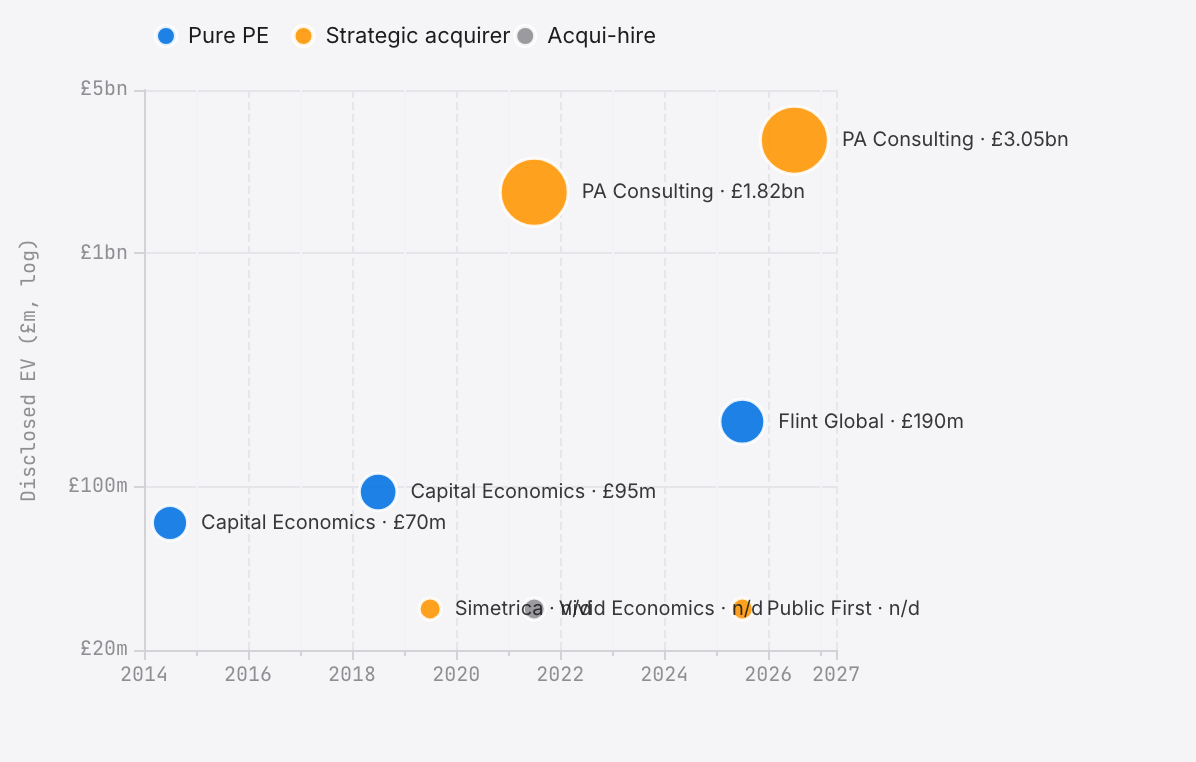
This is not conventional private equity. Jacobs is a public company running a long-horizon roll-up: no fund expiry, limited partners or two-and-twenty. It shares the sponsor thesis that UK regulated-industry advice offers defensible margins and an ageing ownership base. The vehicle differs. Jacobs absorbs companies into a global services business and keeps them.
This is the strategic-acquirer route. The private-equity cases here buy, add debt, grow and sell on a fund timetable. Strategic buyers integrate and hold. McKinsey acquired Vivid Economics and Planetrics, then placed the team inside McKinsey Sustainability. Jacobs bought a majority of PA, acquired the remainder and kept the brand. The direction is similar; the mechanics are not.
Three numbers complete the picture. Jacobs owns 100 per cent of PA Consulting and 100 per cent of Simetrica-Jacobs. It described the remaining-stake deal as margin-accretive and tied to higher-value advisory and digital work. The £3.05 billion valuation is the cleanest disclosed benchmark for future UK advisory comparisons.
Section 4: Econic Partners, the story of 2025
In February 2025, Econic’s launch release named Jonathan Orszag, Mark Israel, Kirsten Edwards-Warren and Catherine Barron as founders of a firm with more than 25 economists. Goldman Sachs Alternatives and the Willig and Ordover families supplied the financing.
FTI’s investor materials quantify the disruption. In its February 2025 earnings call, management warned that senior departures from Compass Lexecon’s American competition practice could materially hurt revenue and profit. It used $35 million as an order-of-magnitude guide. The Q1 2025 results reported Economic Consulting revenue of $179.9 million, down 12.1 per cent year on year, and a 6.6 per cent fall in billable headcount.
The conclusion here is narrower than the press drama: expert-witness economics appears unusually attached to individuals. FTI’s account of the departures, Econic’s expert-led launch and the project people ledger all support that reading. They do not make it a law of the market.
The family money adds a twist. Robert Willig and Janusz Ordover co-founded COMPASS, a predecessor of Compass Lexecon, in 2003. The firm’s history says COMPASS and Lexecon combined in 2008. Econic’s release names the Willig and Ordover families as investors in the new firm. In 2025 the founders’ families backed a breakaway from the brand their predecessors helped create.
The parallel with 2002 is useful, not exact. As Part 2 recounts, Ridyard, Bishop and Baker left NERA to build a partnership. By FY2025, RBB’s accounts show higher profit per member than any NERA row in this project’s UK filings.
The pattern repeated in 2025: senior people left an incumbent, formed a new economics partnership and fought over clients and staff. But Econic launched with institutional backing from Goldman Sachs Alternatives; RBB began as a smaller NERA spinout. Whether Econic can reproduce RBB’s economics is a forecast, not a fact in the filings.
The 23-year gap invites comparison, not prediction. The ledger cannot tell us whether the 2025 spinout will age like the 2002 one.
Econic has called its UK expansion aggressive in comments to the legal press. Hires from Compass Lexecon’s Madrid, Brussels and Berlin offices followed the London team; competing mandates on the same mergers soon appeared. The test is whether a funded breakaway can keep both its senior people and its case pipeline.
Section 5: The firm-by-firm picture
These firms run different models, as their accounts show. The snapshots use the latest rows in the project ledger.
Different margins, different models
Brattle Group UK. Its latest UK filing in the dataset reports £39.4 million of turnover, an operating loss of £0.9 million and four outstanding Companies House charges. It does not explain how the American parent funds or manages the operation.
Frontier Economics. Revenue reached £97 million in FY25, up from £86 million in FY24; operating profit was £1.4 million in both years. Frontier is employee-owned. Its thin reported margin is consistent with profit reaching staff through salaries and bonuses rather than the residual operating line, though the accounts do not confirm that interpretation. The comparison with RBB is imperfect: RBB distributes profit to 18 LLP members; Frontier distributes value through staff ownership.
High performers
RBB Economics. The outlier: £3.34 million per member, the highest figure in this project’s detailed-account LLP sample.
A&M Europe LLP. Revenue of €301 million and a top earner on €14.2 million—the largest disclosed member entitlement in the database. A&M’s European partnership spans litigation, restructuring and advisory work. Its cash figure is not a clean comparison with RBB’s competition boutique.
Baringa Partners. Revenue of £450 million, 178 partners and an estimated top earner on roughly £11.3 million. The last figure is derived, not disclosed: seven per cent of the £161.9 million discretionary profit pool in note 12. Baringa is the clearest scale story in the file. Revenue rose sharply; the partnership rose with it.
Flint Global. Revenue of £31 million and an operating margin of 30 per cent. In 2025 Cinven agreed a majority investment. The official release gave no terms. Bloomberg reported an enterprise value of about £190 million, or roughly ~16x EV/EBITDA; neither figure is officially confirmed.
Fideres Partners. A private and opaque litigation-economics specialist growing through class-action damages work in competition and financial services. It is increasingly visible in UK collective proceedings before the Competition Appeal Tribunal.
Interesting
Public First was acquired by Stonehaven on 25 March 2025, part of Peter Lyburn’s roll-up of UK public-affairs and policy advisers. Founders Rachel Wolf and James Frayne remain. Stonehaven now owns a substantial Westminster political and policy stack.
Oxford Economics had begun its succession before founder John Walker died in March 2026. A transition announced on 4 December 2025 made Innes McFee chief executive, appointed Neil Walker deputy chief executive and a board member, and moved Adrian Cooper to executive chairman. The firm remains private, family-controlled and one of Britain’s main independent macroeconomic forecasters.
Section 6: The shape of the whole
The project catalogue covers 90 firms associated with UK economics consultancy. It is a curated directory, not a census. In the interactive explorer, 30 legal entities with positive turnover observations report £2.4418bn in aggregate. The conversion uses €1=£0.85 and $1=£0.78 for two foreign-currency rows. Figures are the latest available for each entity, with year-ends ranging from July 2024 to December 2025.
The total includes non-economics work inside broad and litigation consultancies. It is neither a sector estimate nor a market floor. For comparison, Cebr reported sector revenue of £1.53bn in 2016/17 and a historical three-year average growth rate of 11.3 per cent. Extending that rate mechanically for eight years produces £3.60bn in 2024/25. That is the author’s scenario, not Cebr’s forecast or a bound on today’s market.
The database holds structural fields for 87 internal firm rows. These cover 15 standalone LLPs, 8 companies with a disclosed parent and 63 other companies. One final row is a brand pointer from Compass Lexecon to FTI Consulting LLP.
Partner-owned LLPs
- RBB, Oxera, Baringa, FTI, AlixPartners
- A&M Europe, A&M Tax, A&M Disputes
- Fideres, Independent Economics, Macro Advisory Partners
- Plum, Reckon, Volterra, York Aviation
Ltd with disclosed parent
- CRA, Aviation Economics, CEPA, Continuum (4cast)
- ECA, London Economics (Indecon), Simetrica-Jacobs, WPI Strategy
Other Ltd (independent or unflagged)
- Oxford Economics, Capital Economics, Cambridge Econometrics, Europe Economics, DotEcon, Aether, Cebr, Public First, and other independent or unflagged companies in the directory.
Dual-seat directors
- Hold active director seats at two registered entities simultaneously — in every case sister companies within the same group (Capital Economics and its research arm; ECA Economics and Economic Consulting Associates). Genuinely cross-firm dual directorships do not appear in the register.
Status events, 2023–2026
- Vivid: entered MVL 2023; dissolved 27 May 2026.
- Econic: incorporated December 2024 (launched February 2025)
An earlier version used a 24/12/39 split (Foreign-PE / LLP / Independent) drawn from public ownership information not yet captured in the database. The true number of foreign- and PE-owned UK economics consultancies is plainly higher than the six flagged by the DB. The DB alone cannot reconcile it.
The long tail is largely invisible. In the working database, 43 of the 87 CH-registered firm rows lack a usable turnover figure for every extracted year. Across the wider 90-firm coverage map, 35 firms have financial rows but no usable turnover; another 12 lack extracted financials or a clean standalone CH practice entity. Many are small regulatory or policy teams. Some will grow. Others may remain too small or opaque ever to disclose clean turnover.
The damages dividend
Cartel-damages litigation may have contributed to the post-2020 revenue curves. The European Commission’s trucks-cartel decision of 19 July 2016 imposed what was then the EU’s largest cartel fine: €2.93bn on MAN, Volvo/Renault, Daimler, Iveco and DAF for fourteen years of collusion. It later fined Scania another €880m in September 2017.
The fines were the opening act. Follow-on damages claims occupied the Competition Appeal Tribunal for years. The Supreme Court’s Merricks v Mastercard judgment of December 2020 addressed certification of opt-out collective actions. Afterwards, more than fifty collective actions were filed with the CAT.
The first trucks claim to reach a full trial was Royal Mail and BT v DAF in February 2023. The parties filed about 48 expert reports and devoted twelve of the twenty-five trial days to expert evidence. Economic Insight’s James Harvey appeared for the claimants; a Compass Lexecon team led by Damien Neven appeared for DAF. The Tribunal used a “broad axe” 5 per cent overcharge and awarded roughly £39m. It also said both sides’ conclusions were “clearly influenced in favour of the commercial interests of their respective clients”.
The timing, volume of expert evidence and firms’ marketing of dispute practices make damages work a plausible source of growth. No firm discloses the revenue involved. The filed accounts therefore cannot establish causation.
Section 7: Six forces, 2025-2050
The next section is a forecast, not a filing fact. The evidence above already reveals six forces.
Six forces, 2025-2050
- Generational succession. The series covers RBB (2002), Frontier (1999), Oxera (1982), Capital Economics (1999) and Oxford Economics (1981). Oxford Economics had announced a leadership transition before John Walker’s death in March 2026. The examples already divide into routes: Oxford Economics passed leadership to Innes McFee and Neil Walker; Flint agreed a PE majority investment; Vivid sold to a strategy house. More founder-led firms may face versions of those choices.
- Econic against Compass Lexecon. The live question is whether Econic becomes an elite breakaway at scale or whether Compass Lexecon defends its incumbent position. The pattern from the NERA-RBB split points one way; Compass Lexecon's long record and corporate backing point the other. This is a watch item, not a settled conclusion.
- What AI does to the practice. Competition economics, litigation damages and market modelling face different risks. Expert-witness work, where a partner’s reputation signs the report, looks relatively insulated. Computational models such as Cambridge Econometrics’s E3ME and other CGE frameworks could thrive if AI extends each modeller’s reach. They could also suffer if general-purpose tools reproduce more of their work at low marginal cost. Policy evaluation sits in the middle.
- Climate economics consolidation. McKinsey's Vivid acquisition gives one clear precedent. Cambridge Econometrics has model IP; eftec has regulatory credibility; Aurora Energy Research has data and energy-market reach. Those traits make the green-consulting space a plausible consolidation field, but which buyer moves next is a scenario, not a filing fact.
- Buyer pluralism. Section 3 identified two active groups: financial sponsors that buy, grow and sell, and strategic acquirers that buy, integrate and hold. Buyers may study mid-sized founder-led specialists such as Cebr, Europe Economics, Aether and DotEcon. Any target list, however, is an analytical watchlist—not evidence of a sale process. (Update, March 2026: Capital Economics’ PE debt structure has changed. The original Phoenix-era charges to Glas Trust Corporation Limited were satisfied in March 2026. New charges to Ocorian Trustee (UK) Limited, trading as Nordic Trustee, were created in November 2024 and January 2025. They are consistent with a refinancing or secondary PE transaction. The template is not static.)
- The Big Four economics practices. Deloitte, PwC, KPMG, and EY run economics arms, but the project ledger does not identify separate statutory revenue rows or standalone public P&Ls for those practices. Whether these practices grow into proper economics brands or are absorbed into generic advisory is the open question. The evidence is not strong enough to say which remain distinct brands.
Closing
The ledger follows the industry from 2000 to 2025. It begins with NERA as a central incumbent and Frontier Economics barely a year old. It ends with RBB posting the sample’s highest profit per partner and a Goldman-backed spinout ranked Elite in its first year. Selected legal entities also report more than £2 billion of turnover across mixed accounting periods. That is not the size of the market.
A future edition will probably start with the same raw material: Companies House filings, LLP disclosures, PSC records and deal announcements. The story will change. The evidence will still begin in Cardiff, where little-known firms file accounts that sometimes reveal partner economics to rival much more famous professions.
Ownership is the industry’s quiet hinge. Economists spend decades at NERA, Oxera, Frontier, Compass Lexecon or RBB, reach the top, then decide whether to inherit the institution or build its successor. This series begins that cycle with Ridyard, Bishop and Baker. Orszag and Barron now continue it at Econic. The next edition may carry different names.
Part 6: The CMA Drain
Part 6 follows moves from the CMA into consultancy, leadership churn at Keystone, AlixPartners’ competition hiring and the wider revolving door through Ofgem, Ofcom, DG Competition and the Treasury.
Read Part 6 →